Detalle de: Biomolecular Interactions & Structural Glycobiology Lab
| Title | Biomolecular Interactions & Structural Glycobiology Lab |
| Description |
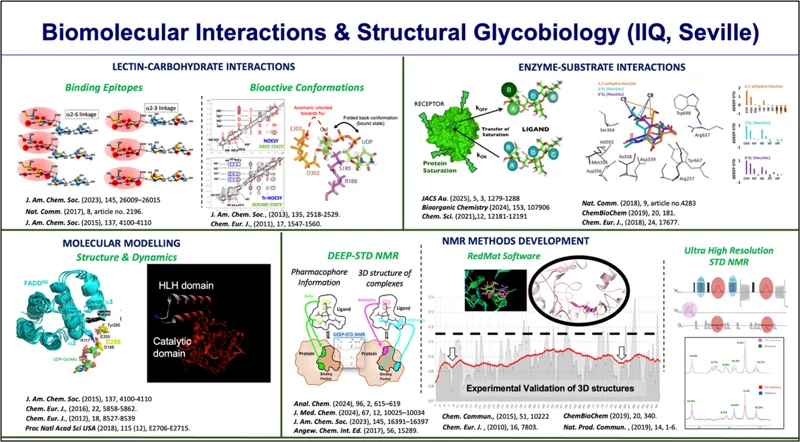
The Biomolecular Interactions & Structural Glycobiology Group (BISG), located at the Institute of Chemical Research (IIQ-CSIC/University of Seville), investigates the chemistry of biomolecular recognition with the mission of facilitating an atomic-resolution understanding of biologically relevant biomolecular and biomaterial interactions from structural and dynamic perspectives. The group specialises in the rational molecular design of new ligands, including both inhibitors and activators, targeted at biologically relevant proteins through the development of an integrated platform that combines cutting-edge experimental and computational methodologies. Central to this mission are pioneering advanced nuclear magnetic resonance (NMR) spectroscopy techniques and molecular modelling approaches that enable the rapid characterisation of weak protein-ligand complexes, structure-activity relationships, and the orientation of bioactive ligands at protein binding sites. The laboratory has developed transformative technologies including NMR-based affinity determination using saturation transfer difference (STD), the DEEP-STD NMR method for ligand orientation, the RedMat and RedDat software platforms to accelerate the validation of 3D complexes and the mapping of binding epitopes, and the SHARPER NMR ultra-fast ligand ranking method for rapid prioritisation of ligand affinities—tools that significantly improve the efficiency of fragment-based and structure-guided drug discovery programmes. A distinctive research emphasis focuses on carbohydrate- and glycan-based systems, encompassing glycosaminoglycans, glycomimetics, and glycoprotein interactions, with applications ranging from immune receptor recognition and antimicrobial therapies to pathogenic infection mechanisms and enzyme catalysis.
Driven by significant international collaborations and evident recognition in publications in journals such as the Journal of the American Chemical Society, Angewandte Chemie, Nature Communications, and Nature Microbiology, among others, combined with expertise in machine learning-assisted NMR for the characterisation of protein-ligand interactions, the BISG group is developing a comprehensive set of experimental and computational tools to advance molecular design and accelerate the path from concept to validated therapeutic candidates. Main research areas
|
| Home Page | https://www.iiq.us-csic.es/grupos-investigacion/interacciones-biomoleculares-y-glicobiologia-estructural/?lang=en |
| Contact Email | jesus@iiq.csic.es |
| Collaborating Companies | |
| Spin Off | |
| Patents | |
| Hpc Resources | |
| Institution | IIQ |
| Ontology | Machine Learning in Biology, Bioinformatics Software and Tools, Experimental structure determination, Biomolecular simulation, Molecular Interactions/Docking |
| Tools | |
| Service Units | |
| Research Lines | Structural basis of biomolecular recognition, NMR, molecular modelling and AI approaches for biomolecular interactions |
| Funded Projects | GlyCanDrug: A training network on the design of precision therapeutics that target key glycan motifs implicated in cancer, GlycoNoVi: Understanding the Role of Glycans in Human Norovirus Infection: a Key to Unlock New Therapies, Learning to Design Sweet Renewable Hydrogels – Development of Experimental Protocols and Deep Learning Models to Decode Complex Structure-Function Relationships (Sweet2Gel), Machine Learning for Low Affinities — Towards Accelerating the Generation of NMR-validated Protein-Fragment Complexes and Glycomaterials Design, Machine Learning for the Acceleration and Optimization of Pharmacophores for the Design of New Medicines by STD NMR, Química estructural de interacciones biomol. débiles: STD NMR, Mutation Screening y Machine Learning para acceder al colectivo dinámico 3D. Inhibición de glicosiltransferasas, A 19F-Protein and 1H-Ligand NMR toolkit to design inhibitors of bacterial virulence effectors, Nuevas Herramientas STD NMR para obtener Estructuras 3D de Complejos Proteina-Ligando Débiles: Aplicación a Interacciones Proteína-Carbohidrato Biológicamente Relevantes |
| Selected Publications |
View all (7 more)
|
| Researchers | Juan Carlos Muñoz García |