Detalle de: Protein Design and Modeling
| Title | Protein Design and Modeling |
| Description |
Proteins are extraordinarily versatile biomolecules that carry out a broad range of functions in life – including molecular recognition, catalysis, transport and scaffolding – and uniquely inspire us for engineering molecular solutions to current challenges in therapeutics, synthetic biology, green chemistry, nanomaterials and, more generally, biological research. Our current understanding of how protein sequences dictate three-dimensional structures now enables us to tackle the reverse challenge: designing from first principles protein sequences folding into desired structures, also known as “de novo protein design”. The need for designing and tailoring proteins from scratch is clear: repurposing natural proteins leads to suboptimal or no results in many applications. Despite their proficiency, natural proteins generally suffer from a series of limitations when repurposed for new functions: instability, not having the desired geometry or size, too low recombinant expression levels for large-scale production, exhibiting undesired interactions with other proteins or folding through too complex processes, among others. The de novo protein design revolution has arrived to transform the way we engineer proteins; opening the door to a universe of hyperstable proteins designable with high structural accuracy and enough complexity for tailoring functions of medical and biotechnological relevance.
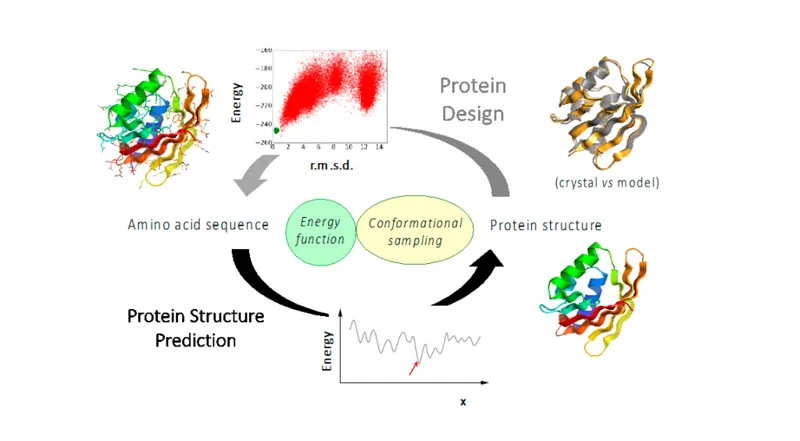
Figure legend. Protein design and structure prediction are two opposite and synergizing problems favoring the development of energy functions and conformational sampling strategies satisfying the principle that the structure of well-folded proteins corresponds to the global energy minima of their amino acid sequence. Our goal in the Protein Design and Modeling Lab is to combine computational methods and experimental characterization to design brand new proteins for biotechnological and medical applications. We believe that computation and experiment together make the whole design process more efficient, exciting and rewarding. We start by computationally designing proteins using the Rosetta macromolecular modelling software – we belong to the Rosetta Commons – and validate their sequence-structure compatibility with structure prediction simulations. Then, to experimentally verify that the designs behave as predicted, we recombinantly express genes encoding for the designed sequences and characterize the proteins by combining biochemical and biophysical techniques (circular dichroism, MALS…) with X-ray crystallography. Our multidisciplinary research aims at developing design principles and expanding computational protein design methodologies for novel protein folds, binders to small-molecules or proteins, as well as conformational protein switches responding to signals. We are also interested in how computational design pipelines can be improved to increase their predictive power and minimize experimental screening. Towards this goal, we are exploring molecular dynamics simulations and enhanced sampling techniques as stringent validation tests of designer proteins in silico. Our vision is to make de novo protein design a robust approach that is widely accessible to many laboratories and industrial companies interested in different areas of biology and biotechnology. Major advances in de novo protein design made in the last decade have resulted in a burst of de novo proteins in manifold geometries with high stability and experimental structures matching their computational models. We have contributed to a number of studies adding to de novo proteins the complexity necessary for ligand-binding functions. We have described the first de novo designed proteins made only with beta-sheets, which are attractive frameworks for enzymes, small-molecule binders and antibodies. Despite more than 20 years of protein design research, the design of all-beta proteins had remained elusive due to their higher structural complexity and aggregation propensity. We have identified design principles for designing well-packed all-beta proteins using long-range loop connections between beta-strands, and computationally designed double-stranded beta-helices with the jelly-roll fold at atomic-level accuracy. This study has opened the door to custom-design a broad range of beta-sheet proteins suited for binding sites, including de novo beta-sandwiches with the immunoglobulin fold as novel antibody frameworks.
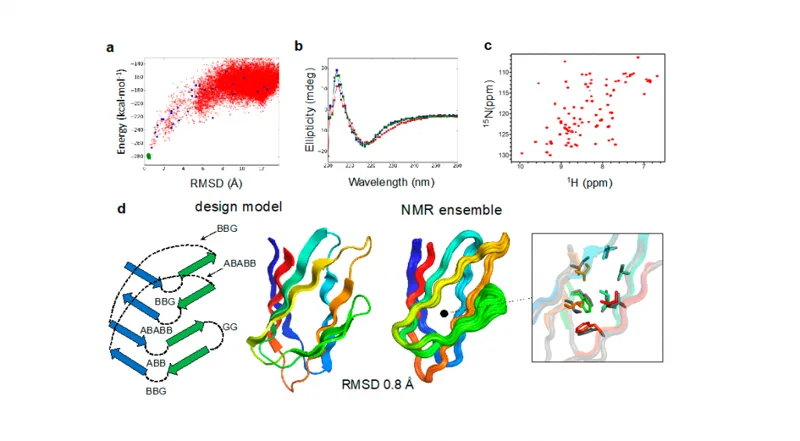
Figure Legend. De novo design of a double stranded beta-helix. (a) Computationally designed sequences with funnel-shaped energy landscapes were then expressed in E coli and (b) their secondary structure and thermostability was confirmed with circular dichroism. (c) The formation of well-folded structures was verified by nuclear magnetic resonance HSQC. (d) The structure of the best design model was solved by nuclear magnetic resonance in excellent agreement with the computational model. Based on structural analysis of natural proteins we have identified the mechanisms by which natural proteins bend beta-sheets when building binding pockets, and then developed a computational approach for de novo designing NTF2-like protein folds with cavities controlled by curved beta-sheets, which are ideal protein scaffolds for tailoring small-molecule binding sites in biosensing and biocatalysis applications.
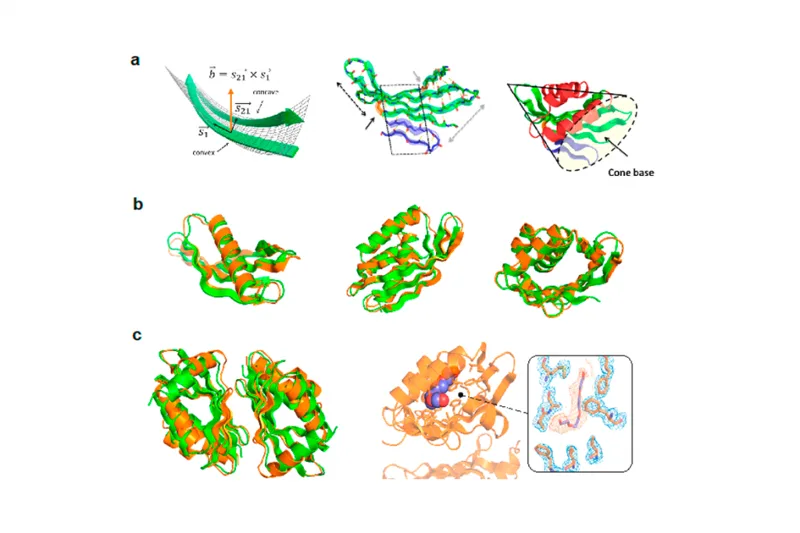
Figure Legend. De novo design of proteins with cavities controlled by curved beta-sheets. (a) Analysis of beta-sheet curvature and identification of topological parameters controlling beta-sheet geometry and that were used to build cone-like structures for hosting cavities. (b) Examples of designed proteins with X-ray or NMR structures matching their computational models. (c) Homodimers designed for enhancing stability and growing buried cavities able to bind small-molecules. |
| Home Page | https://ibmb.csic.es/en/department-of-structural-and-molecular-biology/protein-design-and-modeling/ |
| Contact Email | embcri@ibmb.csic.es |
| Collaborating Companies | |
| Spin Off | |
| Patents | |
| Hpc Resources | |
| Institution | IBMB |
| Ontology | Computational Methods, Applications of Computational Biology, Structural bioinformatics, Computational models and simulations, Mutation Analysis and design, Biomolecular simulation, Drug Discovery and design, Structure prediction, Molecular Interactions/Docking |
| Tools | |
| Service Units | |
| Research Lines | De novo design of beta-sheet proteins, De novo design of small-molecule binding proteins, Design of protein binders and conformational switches, In silico validation of designed proteins |
| Funded Projects | Revolutionizing Protein Drug Development – AI-driven Protein Engineering for Next-Generation Enzyme Therapy |
| Selected Publications |
View all (2 more)
|
| Researchers | Enrique Marcos Benteo, Mario López Martín |