Detalle de: Systems Biotechnology Group
| Title | Systems Biotechnology Group |
| Description |
SummaryWe applied a multidisciplinary approach including metabolic modelling, systems and synthetic biology to study bacterial metabolism from cellular to population level. Our final goal is to create a biological framework that allows the development of a broad range of novel and non-intuitive biotechnological processes, such as bioremediation solutions and sustainable production alternatives. Research LinesIncreasing the completeness and scope of metabolic reconstructions We are committed to building a niche-specific collection of standardised and highly reproducible metabolic models. In pursuit of this goal, we have dedicated ourselves to developing high-quality models for a wide range of metabolically diverse microorganisms. We place particular emphasis on expanding the scope of metabolic modelling by incorporating new modules that capture important aspects of microbial metabolism. This includes modeling the generation of endogenous reactive oxygen species, underground metabolism, metabolic heterogeneity, and condition-specific biomass production. By incorporating these additional components, we aim to enhance the accuracy and applicability of our models, enabling a deeper understanding of microbial physiology and facilitating the design of innovative biotechnological and clinical solutions. Disentangling the driving forces behind metabolic processes Microbial metabolism operates and evolves under the trade-off between two principles: optimality under one given condition and minimal adjustment between conditions. These principles give rise to a three-dimensional space characterised by competing objectives: growth, robustness, and adaptability. At our lab, we are dedicated to deciphering the intricate relationship between metabolic robustness, adaptability, and optimality in microbial metabolism. We seek to investigate the mechanisms underlying metabolic cycles that promote high robustness in bacteria and explore how metabolic heterogeneity contributes to microbial survival in the face of perturbations. By gaining a deeper understanding of these fundamental aspects, we aim to apply this knowledge to diverse fields such as biotechnology and clinical microbiology. Our ultimate goal is to leverage this newfound understanding to develop innovative solutions for a wide range of applications.
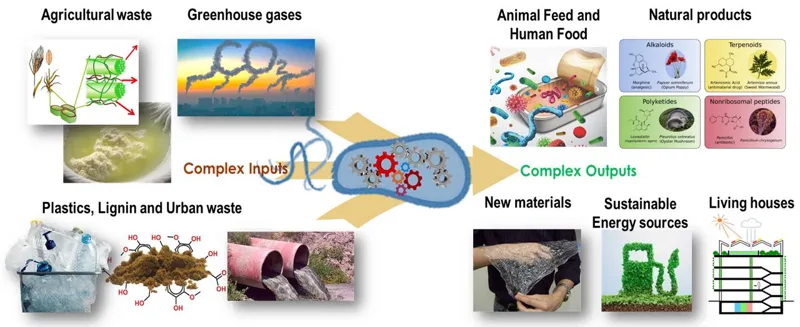
Main Technological Bioprocesses Developed at SBG. The group develops processes for the valorization of recalcitrant waste into high value-added products within the ONE HEALTH framework. To achieve this, we have not only developed a highly competitive iterative optimization cycle (DBTL), but we also utilize advanced microbial metabolism concepts such as division of labor and synthetic differentiation. System level analysis and designing microbial communities The division of labor allows an expanded complexity and functionality in microorganisms. Guided by these interesting features, our research focuses on two key objectives. Firstly, we aim to unravel the mechanisms underlying the emergence of complex capabilities within microbial populations and communities. By studying how microorganisms interact and coordinate their activities, we seek to understand the factors that contribute to their expanded functionality. Secondly, we strive to harness and engineer this supracellular-level functionality for various biotechnological and clinical applications. To achieve this, we have developed a comprehensive suite of systems biology tools and evolutionary engineering frameworks. Our research finds practical application in multiple areas. For instance, we are working towards the valorization of complex polymers like lignin and plastic wastes, aiming to develop sustainable strategies for their use. Additionally, we focus on cost-effective production of plant-based secondary metabolites and the development of animal-free, sustainable ingredients for the food, beverage and nutraceutical industries. Developing a DNA biofoundry towards the AI-guided exploration of microbial chemical space. We are actively involved in the development of a DNA biofoundry (CNBio) that integrates advanced automation, synthetic biology, evolutionary engineering and artificial intelligence (AI) to explore the untapped potential of microbial metabolism. Our goal is to go beyond the limited set of known biochemical transformations and uncover new metabolic pathways that can expand the metabolic space suitable for biotechnological and medical applications. Through the use of advanced automation and synthetic biology techniques, we can design and build genetic circuits and pathways in a systematic and precise manner. This allows us to engineer microorganisms with enhanced metabolic capabilities, opening up new possibilities for the production of valuable compounds. Furthermore, the AI-guided approach enables us to explore the vast chemical landscape of potential transformations and accelerate the discovery and optimization of novel microbial metabolic capabilities.
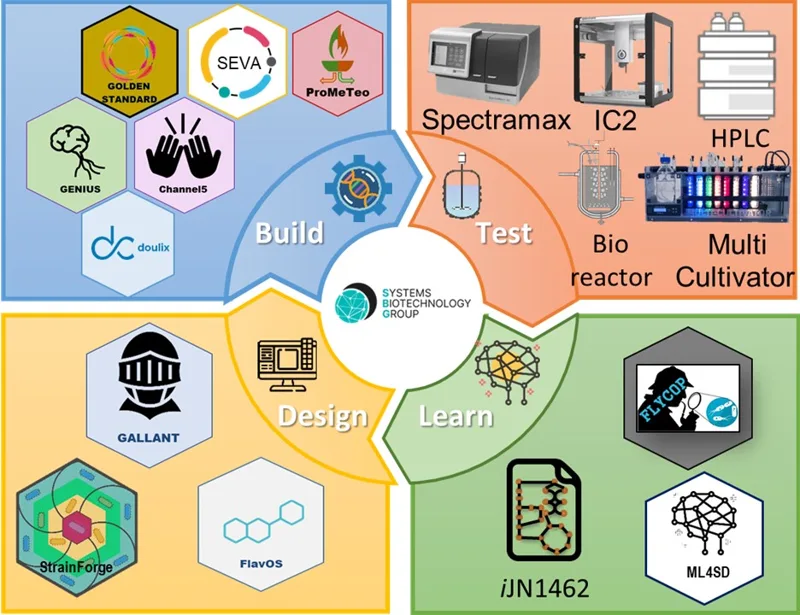
DBTL Cycle Developed at SBG: In recent years, the group has developed a highly integrative and partially automated DBTL cycle. To achieve this, we have created systems biology and artificial intelligence tools for Design and Learn, as well as novel synthetic biology tools in the Build stage to optimize pathway and strain construction. Additionally, the group has developed cutting-edge tools for evolutionary engineering and high-throughput prototyping in the Test stage. |
| Home Page | https://www.cnb.csic.es/investigacion/departamentos/biologia-sistemas/systems-biotechnology-group/ |
| Contact Email | jnogales@cnb.csic.es |
| Collaborating Companies | 1. Moa-FoodTech. https://www.moafoodtech.com/ 2. Pharmamar. https://pharmamar.com/es/ 3. Repsol. https://www.repsol.com/es/index.cshtml |
| Spin Off | 1. Biodriven Technologies. https://www.biodriventech.com/ |
| Patents | 1. Recombinant Pseudomonas putida strains for the production of Polyhydroxyalkanoate. WO 2021/089636 A1 2. A procedure for continuous, growth-coupled and saline stress independent production of sucrose from CO2 using recombinant cyanobacteria strains. WO 2021/148693 A1. |
| Hpc Resources | |
| Institution | CNB |
| Ontology | Omics, Computational Methods, Resources, Transcriptomics, RNA Sequencing (RNA-seq), Data Analysis, Artificial Intelligence, Machine Learning in Biology, Bioinformatics Software and Tools, Analysis packages (R, Python, etc.), Applications of Computational Biology, Model organisms, Genomics, Large language models, Functional genomics, Computational models and simulations, Biosystems Modeling, Metabolic modelling, Systems Biology, DNA methylation, Integrative Analysis, Population genomics, Sequence analysis, Pathway analysis, Metabolomics, Network Biology, Single-cell omics, Single-cell (scRNA-seq), Biological interpretation, Non-model organisms, Microbial communities, Metagenomics, Text mining, Deep Learning in Biology, Amplicon Sequencing, Metatranscriptomics, Synthetic biology |
| Tools | Breaking-Cas, Golden Standard, FLYCOP |
| Service Units | CNBio (CNB DNA Biofoundry) |
| Research Lines | Increasing the completeness and scope of metabolic reconstructions, Understanding and exploiting the multioptimality of microbial metabolism, System level analysis and designing microbial communities, Developing a DNA biofoundry towards the AI-guided exploration of microbial chemical space. |
| Funded Projects | FLAVO-GREEN, Alternative PROteins from MIcrobial fermentation of non-conventional SEA sources for Next-Generation food, feed and non-food bio-based applications, Decipher cytochrome P450 enzymes (CYPs) by digital tools to produce flavonoids and terpenoids, AMBIZIONE, SAAMBA, Rob3D, ZiRO, Design and build a proof-of-concept ‘living architecture’ whose targeted breakthrough is to transform our habitats from inert spaces into programmable sites, Harnessing the power of nature through productive microbial consortia in biotechnology: Measure, Model, Master (PROMICON), Metabolic heterogeneity of monoclonal bacterial cells as a biotechnological tool to produce natural compounds (MENTHOL), Industrial Biotechnology Innovation and Synthetic Biology Accelerator (IBISBA1.0), MIXed plastics biodegradation and UPcycling using microbial communities (MIXUP), Synthetic microbial consortia-based platform for flavonoids production using synthetic biology (SynBio4Flav), Optimizing the Synechococcus-driven microbial Consortia with biotechnological applications by using Systems and Synthetic Biology tools (SyCoSys), System analysis and biotechnological applications of bacterial metabolic robustness at supracellular level (RobExplode), System level analysis of the metabolic robustness in bacteria (RobDcode) |
| Selected Publications |
View all (24 more)
|
| Researchers | Juan Nogales, David San León Granado |